
BRIEF INTRODUCTION
In 1992, the first conference on climate change was organized by United Nations in Rio de Jeneiro which failed and continuously failed for the next 23 years until Paris Agreement in 2015 during COP21. In 2026, my fuel prices are increasing which are affecting the prices of almost everything, that's not because of my Prime Minister Narendra Modi rather because of the wars. Meanwhile Norwegian reporter is asking my PM, "Why should I trust India?" after knowing that Germany is their one of the largest trading partner and Adolf Hitler had invaded Norway, slaughtered Norwegian people, made them prisoners of war and built Blood Road while India has never invaded anyone. And, United Nations is strongly criticizing the wars while failing to stop any.
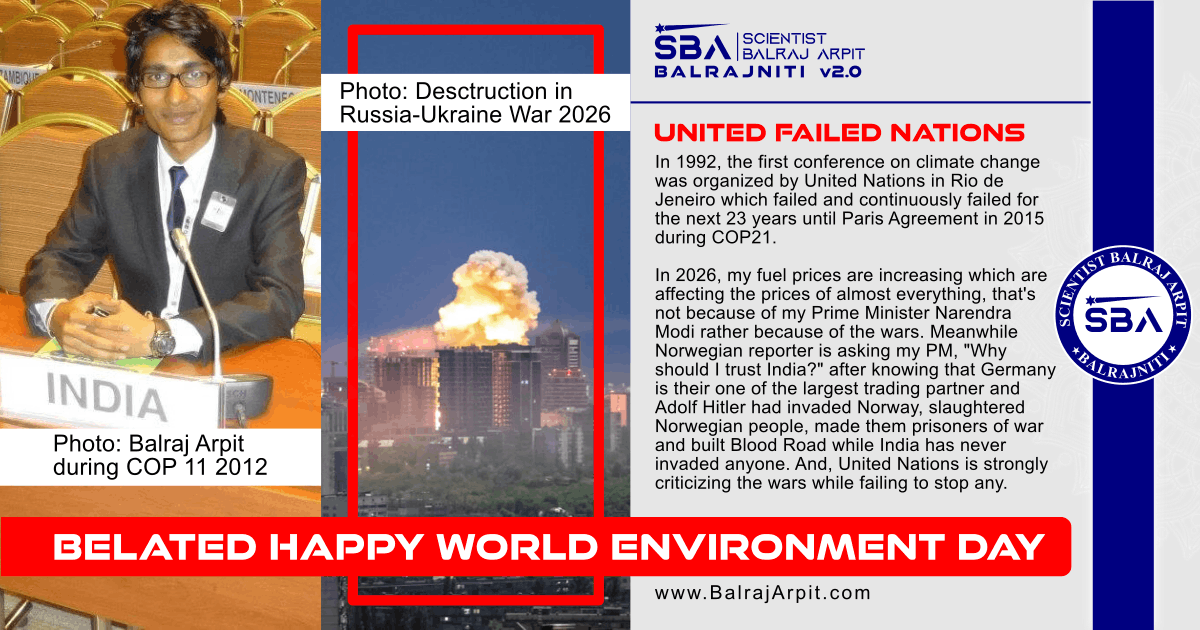
Every year on World Environment Day and climate change conferences, world leaders gather, make speeches, sign declarations, pose for photographs, and promise a greener future. Yet every year, the planet becomes warmer, conflicts become more destructive, and ordinary citizens pay the price.
The modern climate movement gained global momentum after the 1992 Earth Summit in Rio de Janeiro. Since then, the United Nations has organized countless climate conferences, negotiations, and conventions. While these efforts eventually led to the Paris Agreement during COP21 in 2015, the uncomfortable truth is that global emissions continue to rise, environmental degradation continues, and geopolitical conflicts continue to undermine sustainability efforts.
Today, in 2026, fuel prices are increasing and affecting the cost of almost everything we use. This is not simply because of domestic political decisions; global conflicts and wars disrupt supply chains, energy markets, and international trade. The economic burden is ultimately carried by ordinary citizens across the world.
At the same time, it is ironic to watch reporters from countries with their own complex historical legacies question nations like India. Recently, a Norwegian journalist asked Indian Prime Minister Narendra Modi, "Why should I trust India?" Norway is a respected democracy, but history reminds us that during the Second World War, Nazi Germany invaded Norway, killed civilians, imprisoned citizens, and forced prisoners to construct projects such as the infamous Blood Road. India, despite its own challenges, has never pursued a history of global conquest comparable to many colonial powers.
Meanwhile, the United Nations continues issuing statements condemning wars while repeatedly demonstrating its inability to prevent them.
In 2012, I had the privilege of serving as an International Youth Representative of India during COP11, having been recommended by Samsung Engineering. Like many young people, I believed that global cooperation could create meaningful change. I contributed in whatever capacity I could and hoped that future generations would inherit a more sustainable world.
Today, as I work on innovations aligned with the Sustainable Development Goals (SDGs), I increasingly view the inability of global institutions to prevent conflict and environmental damage as one of the greatest failures of our era. Future generations will inherit the consequences of today's inaction.
Rather than simply criticizing, I would like to offer several recommendations.
The current veto structure concentrates extraordinary power in the hands of a few nations. If veto powers are to remain, they should represent countries whose combined population accounts for at least one-third of humanity. Otherwise, the veto system should be abolished entirely in favor of a more democratic and representative governance model.
Any nation seeking to initiate offensive military action should first obtain approval from at least 10 of the 15 members of the United Nations Security Council, including at least 3 of the 5 permanent members. Military action undertaken without such authorization should trigger automatic economic penalties and international sanctions.
If a nation proceeds without such authorization, it should face substantial economic penalties, such as a mandatory international assessment of $1 billion per day during the conflict. These funds should be directed toward:
If the offending nation refuses to comply, coordinated international sanctions should automatically be imposed.
Furthermore, defensive actions taken by the victim nation should not be treated equivalently to the initial act of aggression.
Any nation found by an independent international investigation to have knowingly financed, harbored, trained, armed, or provided safe haven to terrorist organizations should face immediate international consequences.
Upon verified findings, the United Nations should establish an International Security and Financial Oversight Framework under which the offending nation would be subject to enhanced monitoring of its financial institutions, border controls, military expenditures, and foreign aid utilization.
Countries repeatedly found supporting terrorist activities should face:
Funds recovered through penalties and seized assets should be directed toward victims of terrorism, reconstruction efforts, counter-radicalization programs, and community development initiatives.
No nation should be permitted to speak at United Nations while privately enabling, financing, or sheltering terrorists. The international community must treat support for terrorism with the same seriousness as direct participation in armed conflict.
I have many more recommendations that could potentially save the environment, reduce conflicts, improve global governance, and perhaps even justify the existence of the United Nations itself.
Unfortunately, releasing these recommendations publicly would be irresponsible. Therefore, I am prepared to disclose them only after being appointed Secretary-General of the United Nations on a temporary basis with a modest compensation package of $100 million.
To reassure taxpayers worldwide, I solemnly promise to reinvest the entire amount into my startup to develop sustainable technologies, environmental innovations, and practical solutions—an investment strategy that may still produce a better return than several decades of international resolutions, emergency summits, strongly worded statements, and expressions of deep concern.
Should the United Nations decline this generous offer, I will reluctantly continue providing my recommendations free of charge while watching world leaders spend considerably more money discussing the same problems at the next conference.
The planet will not be saved by one day of celebration, one annual conference, or another declaration signed by diplomats.
The environment is protected by the decisions we make every day: how we consume energy, how we innovate, how we govern, and how we prevent conflicts that destroy both human lives and ecosystems.
World Environment Day will matter only when we start behaving as though every day is World Environment Day.
Until then, the speeches will continue, the conferences will continue, and the planet will continue sending us the bill.
Published on 15 Jun 2026, 07:44 PM